Within the suppressing environment of the late-18th-century Japan, there existed popular fiction genres, or gesaku (“frivolous compositions”) as writer Susan Griswold refers to them, which stood as representations of free speech within the nation. While many modern scholars dismiss gesaku as pure fiction that lack introspective value, they actually provide an integral view into the discourse of ideology, culture and power within Japan at the time (Griswold, 235). These stories tended to be popular among the classes that lacked political power, such as artisans and merchants, and the stories themselves were easily available to the public. Popular Japanese fiction was born under the strictly enforced feudal hierarchy that kept the social classes from communicating with each other easily; this was due to artisans and merchants feeling constricted, particularly in Edo, the seat of the Tokugawa central government (Griswold, 236). Some popular genres under gesaku, such as sharebon (witty booklets) and kibyōshi (yellow booklets), had dominated popular fiction for a time; however, both styles eventually came under the suppression of the reform administration due to their negative depictions of the shogunate, and as a result they lost much of their charm (Tanahashi, chapter 53).
As sharebon and kibyōshi had began to wane, new comic genres began to emerge. Following the Kansei Reforms (1787-1793), the kokkeibon (humor books) had become a major fictional genre. The work that had inaugurated the late kokkeibon genre was Traveling the Floating World by Shank’s Mare (1802), a collaboration project between popular sharebon/kibyōshi writer Jippensha Ikku and publisher Murataya Jirobē. The story revolved around two characters, Yaji and Kita, and the mishaps and comical encounters they face as they travel from Edo to Kyoto (Tanahashi, chapter 53). While the kokkeibon genre started with humor more geared towards the higher social classes, the late style of kokkeibon were made to be very casual and easy to understand for all social classes. Another kokkeibon writer with significant merit was Shikitei Sanba, who was able to write stories pointed towards specific genders, and his stories became extremely popular among lower class women. Kokkeibon‘s historical end was marked by Shank’s Mare: Journey to the West by Kanagaki Robun in 1870-6 (Tanahashi, chapter 53).
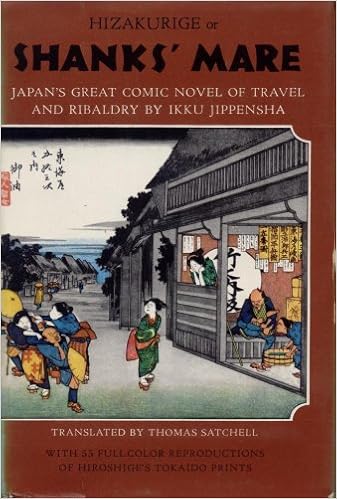
(Cover of a translated version of the travel stories of Jippensha Ikku, courtesy of Amazon.com)
author: amhonigman
Sources:
Griswold, Susan. “The Triumph of Materialism: The Popular Fiction of 18th-Century Japan.” Journal of Popular Culture 29, no. 1 (1995).
Shores, Matthew W. “Jippensha Ikku, Hizakurige, and Comic Storytelling.” Early Modern Japan 20 (2012).
Tanahashi, Masahiro. The Cambridge History of Japanese Literature, edited by Haruo Shirane, Tomi Suzuki, and David Lurie, 523–31. Cambridge: Cambridge University Press, 2016.
