Age of Mappō
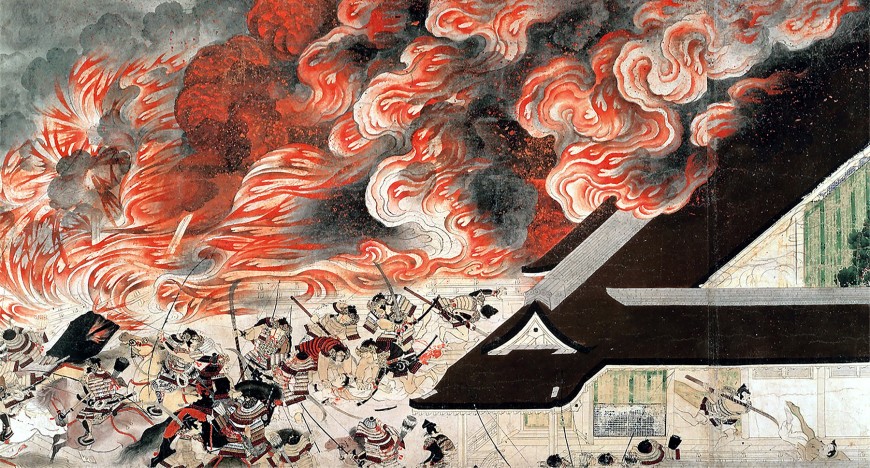
Mappō, in the scheme of Japanese Buddhism, has come to be known as the age of degeneration of the Buddha’s law. The Varley text comes to define it simply as the latter days of the Buddhist law[1]. Dealing with this phenomenon was of concern during the Kamakura Period (1192-1333) and challenge existing Japanese sects of Buddhism with new sects, one of the most important being Nichiren Buddhism. Mappō was of particular importance during the Kamakura Period of Japanese history because this was a particularly violent time that included the rise of the samurai warrior class, the institution of feudalism, and the Mongol Invasions. With a highly militarized society and powerful kingdoms attempting to invade the Japanese mainland it is easy to see how one could jump to the conclusion that these were the last days of Buddhist law.
One of the most common ideas between all Buddhism practicing countries is the idea that upon the Buddha’s death, three separate phases would occur: the True Dharma Age (shōbō), the Imitation Dharma Age (zōbō), and the Last Dharma Age (mappō)[3]. While the idea of three distinct ages is not disputed amongst Buddhists and scholars, what is disputed is the length of years that each age consists of, leading to discrepancies between varying sects of Buddhism. The table below outlines four different theories that scholars and Buddhists have acquired over time.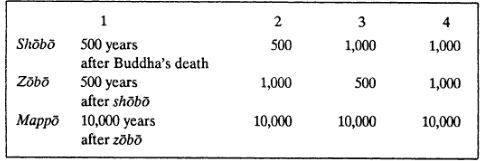
The reason that Mappō, this idea that the days of Buddhist law were numbered, was so frightening was because of the notion that once this age was reached it would mean that no other persons would be able to reach enlightenment through their own practice. By Japanese calculations that year would be 1052, and that one could only find salvation in another in the hope of rebirth, pushing many people to Amidism, specifically the Pure Land sect[4]. While Japanese Buddhism progressed through this vulnerable feeling of impending doom, Mappō remains a powerful concept today in the study of early Japanese Buddhism.
Works Cited
[1] Varley, Paul. Japanese Culture: (Updated and Expanded). 4th ed. Honolulu: University of Hawaii Press, 2000.
[3]Marra, Michele. “The Development of Mappō Thought in Japan (I).” Japanese Journal of Religious Studies 15, no. 1 (1988): 25-54. http://www.jstor.org/stable/30234100.
[4]Ibid., Varley.
Visuals
[1] Night Attack on the Sanjo Palace, Second half of 13th c., Museum of Fine Arts, Boston, MA.
[2]Marra, Michele. “The Development of Mappō Thought in Japan (I).” Japanese Journal of Religious Studies 15, no. 1 (1988): 25-54. http://www.jstor.org/stable/30234100.
