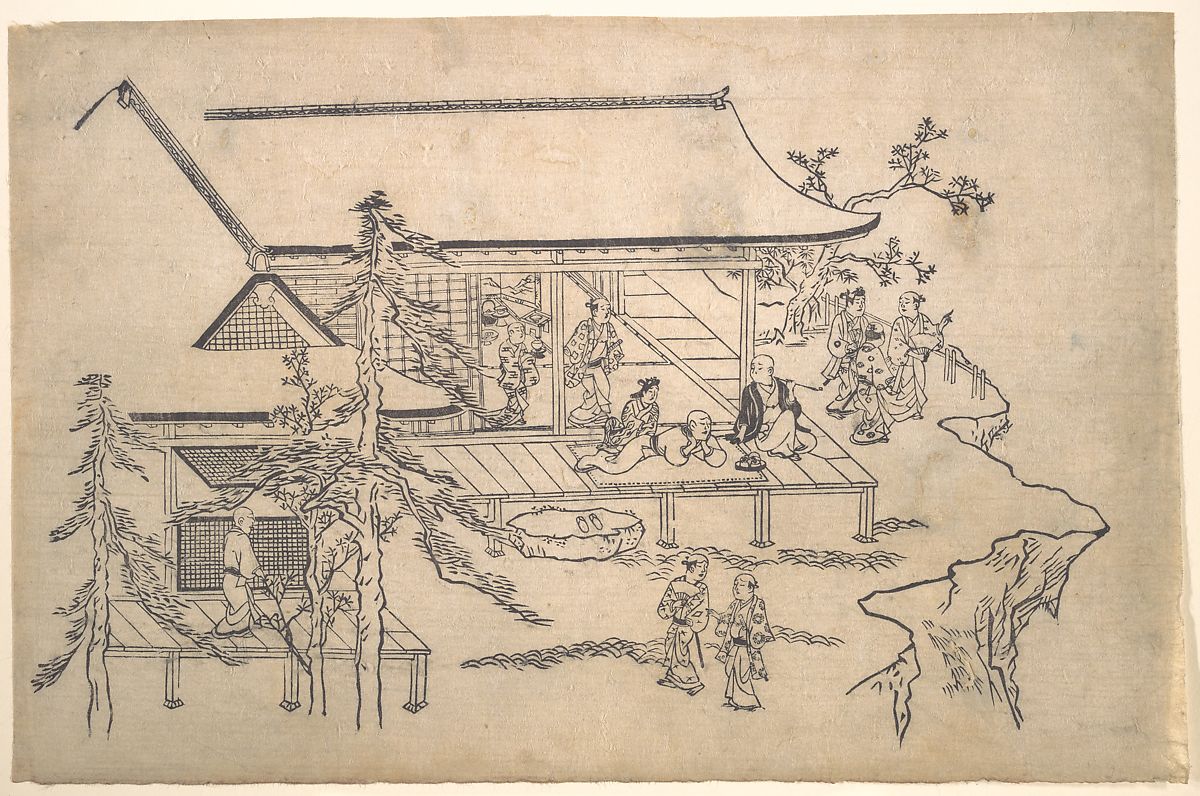
Ukiyo-e is a Japanese art style, made through the technique of woodblock printing, that focuses on depicting everyday life.{1} Landscapes, domestic scenes of women, prostitutes, and actors were frequent subjects of ukiyo-e prints.{2} Hishikawa Moronobu (1618-94), is credited with the establishment and early development of this art form. Moronobu was able to pioneer this art form because he went beyond what most artists of his station were relegated to, autonomous illustration of books. Moronobu created freestanding artwork and albums of his prints which he published with his name on them. By creating freestanding art, his work was more visible than his peers. It was also Moronobu’s decision to employ woodblock printing as his medium that enabled ukiyo-e to stand out from other forms of Japanese artwork, which were typically hand-painted.{3} The use of woodblock printing also made this art form more accessible because it was able to be mass produced, enabling it to meet the demands for luxury goods among the rising middle or merchant class. {4}
Ukiyo-e’s development is divided into three distinct phases. The earliest stage of ukiyo-e is known as the “primitive phase,” during this phase prints were done in black and white.{5} Moronobu, the artist mentioned in the previous paragraph, is associated with this phase.. This phase lasted from the seventeenth century to the mid-eighteenth century. The gradual introduction of color brought the primitive phase of ukiyo-e to a close. {6}
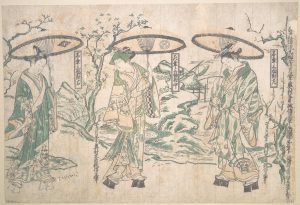
The transition into the second phase or the “middle period” was brought on by Okumura Masanobu (1686–1794), in the mid-eighteenth century, when he introduced a method to produce two color prints or benizuri-e. {7} Benizuri-e were made by
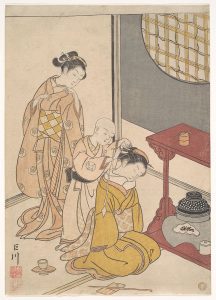
using a separate wood block for each color, common colors being pink and green, and overlaying the two blocks to create the print. The use of pink ink in the print was so important that the name of style, benizuri-e, was derived from it, beni being the Japanese word for pink. Artists using the benizuri-e method often made smaller more delicate prints featuring graceful women. {8} During this phase, Suzuki Harunobu introduced another technique for poly-chrome printing, using numerous blocks, in 1765. {9} Harunobu’s style was called nishiki-e and was more delicate, colorful, and subtle than previous styles of ukiyo-e.{10}
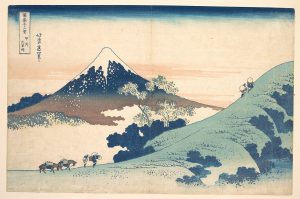
The third period in the development of ukiyo-e, “the late period,” took place during the nineteenth century and is characterized by landscape prints. During this period censorship of ukiyo-e was increasing, this was problematic because up until this period over a quarter of all ukiyo-e being produced were erotic works. So, rather than the human form, artists during this period found inspiration in the natural world.{11}
Footnotes:
{1} “Ukiyo-e,” in The Macmillan Encyclopedia (Aylesbury, UK: Market House Books Ltd, 2003), https://search.credoreference.com/content/entry/move/ukiyo_e_japanese_pictures_of_the_floating_world/0.
{2} Helicon, ed., “Ukiyo-e: Japanese ‘Pictures of the Floating World,’” in The Hutchinson Unabridged Encyclopedia with Atlas and Weather Guide (Helicon, 2018), https://search.credoreference.com/content/entry/heliconhe/ukiyo_e/0.
{3} H.P. Varley, “Flourishing of a Bourgeois Culture,” in Japanese Culture, Japanese History (University of Hawaiʻi Press, 2000), 197–99, https://books.google.com/books?id=BvUEzBin61AC.
{4} Helicon, “Ukiyo-e: Japanese ‘Pictures of the Floating World.’”
{5} Varley, “Flourishing of a Bourgeois Culture,” 197-99.
{6} Helicon, “Ukiyo-e: Japanese ‘Pictures of the Floating World.’”
{7} Encyclopaedia Britannica, “Ukiyo-e,” in Britannica Concise Encyclopedia (Britannica Digital Learning, 2017), https://search.credoreference.com/content/entry/ebconcise/ukiyo_e/0.
{8} Helicon, “Ukiyo-e: Japanese ‘Pictures of the Floating World.’”
{9} Encyclopaedia Britannica, “Ukiyo-e.”
{10} Helicon, “Ukiyo-e: Japanese ‘Pictures of the Floating World.’”
{11} Helicon, “Ukiyo-e: Japanese ‘Pictures of the Floating World.’”
Bibliography
Encyclopaedia Britannica. “Ukiyo-e.” In Britannica Concise Encyclopedia. Britannica Digital Learning, 2017. https://search.credoreference.com/content/entry/ebconcise/ukiyo_e/0.
Helicon, ed. “Ukiyo-e: Japanese ‘Pictures of the Floating World.’” In The Hutchinson Unabridged Encyclopedia with Atlas and Weather Guide. Helicon, 2018. https://search.credoreference.com/content/entry/heliconhe/ukiyo_e/0.
Hishikawa Moronobu. Flower-Viewing Scene. 1685. Woodblock Print, 11 x 16 1/4 in. Metropolitan Museum of Art. https://www.metmuseum.org/art/collection/search/56825.
Katsushika Hokusai. Fuji from the Pass. Woodblock Print, 14 1/4 x 9 1/4 in. Metropolitan Museum of Art. Accessed April 17, 2019. https://www.metmuseum.org/art/collection/search/56697.
Okumura Masanobu. Triptych of Umbrellas. Edo Period. Woodblock Print, 11 3/4 in. x 16 in. Metropolitan Museum of Art. https://www.metmuseum.org/art/collection/search/55752.
Suzuki Harunobu. Night Rain at the Double-Shelf Stand. 1766. Woodblock Print, 11 1/4 x 8 in. Metropolitan Museum of Art. https://www.metmuseum.org/art/collection/search/37145.
“Ukiyo-e.” In The Macmillan Encyclopedia. Aylesbury, UK: Market House Books Ltd, 2003. https://search.credoreference.com/content/entry/move/ukiyo_e_japanese_pictures_of_the_floating_world/0.
Varley, H.P. “Flourishing of a Bourgeois Culture.” In Japanese Culture, 197–203. Japanese History. University of Hawaiʻi Press, 2000. https://books.google.com/books?id=BvUEzBin61A
