- Shingon: “True Word” Buddhism.
- Mandala: The act of meditation that was formed from both Indian and Chinese beliefs and brought to Japan by Kūkai and Saichō
- Mantra: The words or sounds used in the Mandala. Verbal Rituals
- Mudra: The physical position of the body (most specifically the hand signs). Somatic Rituals.
- Esoteric: Temples or cultures would have their own best practices. Kūkai and Saichō traveled collecting these best practices to bring effective Buddhism to Japan. Esoteric literally meaning from or kept inside.
- Dharani: Synonymous to Mantra. Indian vs Chinese translations
Shingon Buddhism is a sect of Buddhist practice that originates from Indian practices of Mantra. Kūkai (774AD – 835AD), the “transmitter of esoteric Buddhism from China to Japan, and the founder of Shingon Buddhism”[1] began his education on track to become a bureaucrat, but decided to take his studies to the mountaintops of China (805 AD) in a search for a sense of self. He and his contemporary, Saichō (767 AD – 822 AD), showed such proficiency that they received initiation under a disciple of Amoghavajra in India, one of the “Eight Patriarchs of the Doctrine in Shingon Buddhism”[2]. Kūkai began to travel all over Japan, teaching the ways of esoteric Buddhism, looking for people who showed proficiency enough to warrant becoming followers. He also engaged in many community projects, becoming a kind of supernatural figure who would travel the land creating good where he went.[3]
Shingonshū means “True Word School” in Japanese literature. This comes from the Japanese pronunciation of zhenyan which is Chinese for “true word”, which is translated from the Sanskrit “Mantra”. Shingon now refers to the esoteric beliefs that were put into practice in Japan by Kūkai. These practices “allowed the Buddhist institutions of the Heian period to replace Confucian principles as the ruling ideology of Japan”[4]. The main difference that made Shingon Buddhism appealing to more people, therefore encouraging the cultural shift from Confucianism, was the belief that anyone could achieve this higher level of enlightenment. Practicing the verbal and somatic rituals (Mantra and Mudra) that Kūkai would teach in his travels, certain individuals were believed to have gained “access to the power of the cosmic Buddha Mahāvairocana”. Supernatural feats individuals may have accomplished include but are not limited to “bringing rain and warding off disease and famine, to achieving buddhahood in this very body” [5].
In today’s media, we know of monks as old men who sit on pillows with their hands folded chanting words like ohm. This is actually very reminiscent of Shingon Buddhism. The Mandala was the overall act of the ritual, and it consisted of Mantra, or Dharani, as the verbal element, and Mudra as the physical position that would best act as a conductor of the spiritual energy. Different regions and the monasteries within them would establish their own best practices; using the Mantra that they felt best connected them to the cosmic. Monasteries maintained these practices throughout future cultural periods, trying to maintain isolation from the world around them; even as far into the future as the early 1900’s, where the remaining esoteric Buddhist practices came together under the banner of Shingonshū against Meiji persecution. After World War II, they split back into their separate sub-lineages, reasserting their independence.[6]
Works Cited
Lehnert, Martin (2010). Esoteric Buddhism and the Tantras in East Asia. Brill. p. 351. ISBN 9789004204010.
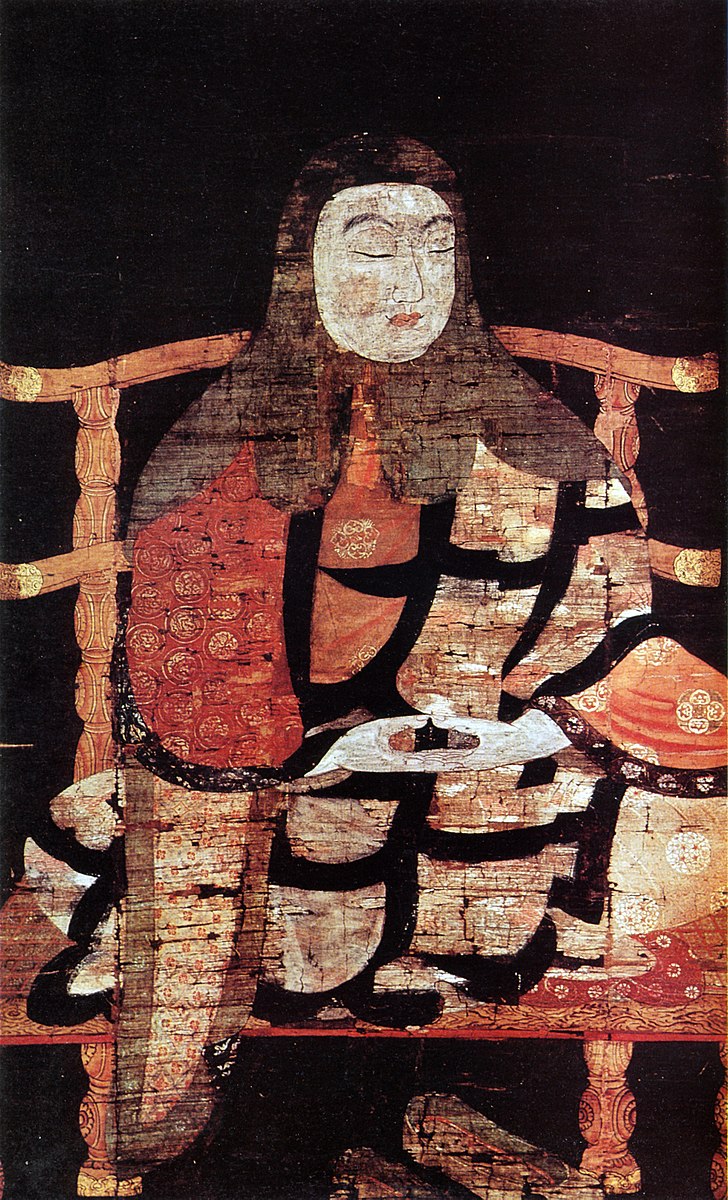
Portrait of Saichō (National Treasure of Japan), he was founder of Tendai Tantric Buddhism. Artist Unknown.
Shingonshū. (2013). In R. E. J. Buswell, & D. S. J. Lopez (Eds.), The Princeton Dictionary of Buddhism. Princeton, NJ: Princeton University Press. Retrieved from https://muhlenberg.idm.oclc.org/login?url=https://search.credoreference.com/content/entry/prdb/shingonshu/0?institutionId=4200
Swanson, P. L. (2007). Kūkai and Shingon Buddhism. In D. Keown, & C. S. Prebish (Eds.), The encyclopedia of Buddhism. London, UK: Routledge. Retrieved from https://muhlenberg.idm.oclc.org/login?url=https://search.credoreference.com/content/entry/routbuddhism/k%C5%ABkai_and_shingon_buddhism/0?institutionId=4200
[1] Swanson: Kūkai and Shingon Buddhism
[2] Lehnert: Esoteric Buddhism
[3] Swanson: Kūkai and Shingon Buddhism
[4] The Princeton Dictionary of Buddhism
[5] The Princeton Dictionary of Buddhism
[6] The Princeton Dictionary of Buddhism
[7] Portrait of Saichō
