Encyclopedia Entry: Kabuki Acting Styles
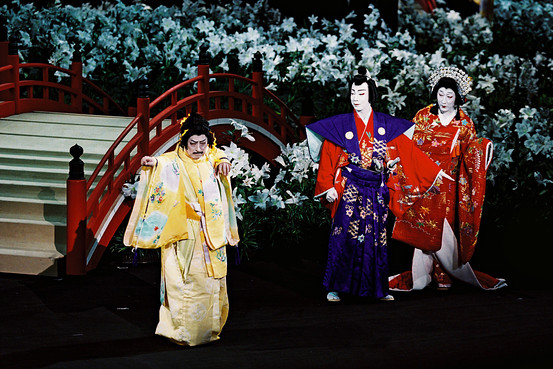
Kabuki relies primarily on the individual actors’ abilities. 1 However, music, specific types of roles, and makeup help to assist the actor to communicate the message and to entertain the audience. There are three main types of roles, all of which are always played by men. Costumes for all three roles may range from a simple monk’s robe to an elegant kimono (like in the picture below) to a huge multilayered costume with eight-foot sleeves. 1 This allows people to be identified by the distinctive garb of their class. 2 Often, the main character will wear one costume, wig, and makeup style in the first half of the play in order to disguise himself. Then, he will change one or more of these attributes onstage during henge (“transformation”) in order to reveal his true identity. 2
The aragato is a rough and masculine role. It mirrors the samurai code and uses striking kumadori makeup to create the illusion of a “painted mask.” 1 It uses multicolored lines to outline the features of the face, legs, and arms to create “power sinews.” 3 This role also uses a huge costume, including superhuman strength and an enormous sword, to create a literally larger than life hero or villian, a high-pitched and strong voice, and large and strong movements. 1,3,4
The wagato is a soft, delicate, and effeminate young male lover role. 1 It is frequently used for weak willed but beautiful and desirable young male lovers, requires a soft and melodic voice and seemingly feminine movements. 1
The onnagata, which depicts an exaggerated, idealized woman. 1 It depicts the ideal woman. As such, these actors, always male, must master a lot of postures and movements, dance forms, and vocal techniques. They usually paint their faces white (as in the picture above.) 1 When they are dancing (as in the photo below), they may remove their outer kimono to dramatically reveal an inner kimono in a technique called hikinuki (“pulling out.”) 2 In earlier days, they were also required to pretend to be a woman in public and to keep their married life secret. 1 Even now, these actors have an unusual appeal that is an interesting and integral part of Kabuki. 1

1 (Watson and McKernie 1993)
2 (Brandon, Malm and Shively 1978)
3 (Kominz 2002)
4 (Scott 1955)
Photographs courtesy of Google Images.
