Zen is the Japanese pronunciation for “chan” in Chinese. The word Zen originates from the sanskrit word “dhyāna” which means meditation (Zen and the Art of Storytelling). Zen Buddhism was introduced in Japan in the 12th century during the Kamakura period. It is a branch of Mahayana Buddhism that challenges the follower to search for enlightenment in themselves. It emphasizes self control, mediation practice, insight into the nature of things, and personal expression (Religions – Buddhism: Zen Buddhism). Zen is concerned with what actually is rather than what we think or feel about what it.
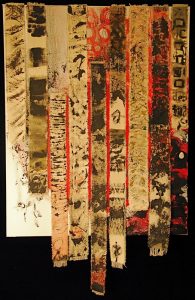
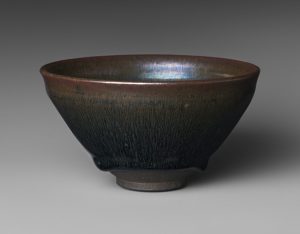
Zen buddhism plays a large role in different Japanese art forms. The Zen aesthetic concept is called Wabi-sabi which sees beauty in things that are imperfect, impermanent, and incomplete (Wabi-Sabi). That emphasis on simplicity and the importance of the natural world generated a distinctive aesthetic that was so attractive to the Japanese. “Wabi” describes the creation of perfect beauty through the inclusion of just the right kind of imperfection, such as an asymmetry in a handmade ceramic bowl. “Sabi” reflects the kind of beauty that develops with age (Wabi-Sabi). In art, Wabi-sabi is manifested in modest, humble, and earthy artworks (Wabi-Sabi). The aesthetic is portrayed in many things: pottery, tea houses, Zen gardens, etc. This is very different from Chinese ideas of beauty, which is interesting because Zen was originally transported from China.

Sources-
“Japanese Aesthetics of Wabi Sabi. Japanese American Artist.” Naomi Lee Gallery. Accessed May 07, 2019. http://naomileegallery.com/wabi-sabi.html.
“The Japanese Tea Ceremony.” Metmuseum.org. Accessed May 07, 2019. https://www.metmuseum.org/toah/hd/jtea/hd_jtea.htm.
“The Tenshin-En at Boston’s Museum of Fine Arts.” PBS. Accessed May 07, 2019. https://www.pbs.org/wgbh/victorygarden/explore/othergardens/mfa.html.
Lawrence, Robyn Griggs. “Wabi-Sabi.” Mother Earth News, no. 244, Feb. 2011, pp. 50–51. Academic Search Complete, EBSCOhost, muhlenberg.idm.oclc.org/login?url=https://search.ebscohost.com/login.aspx?direct=true&db=a9h&AN=57722672&login.asp&site=ehost-live&scope=site. Accessed 29 Mar. 2019.
“Religions – Buddhism: Zen Buddhism.” BBC. October 02, 2002. Accessed March 26, 2019. http://www.bbc.co.uk/religion/religions/buddhism/subdivisions/zen_1.shtml.
Victoria, Albert Museum, and Digital Media. “Japanese Art & Design Themes.” Japanese Art & Design Themes. August 07, 2013. Accessed May 07, 2019. http://www.vam.ac.uk/content/articles/j/japanese-art-and-design-themes/.
“Zen and the Art of Storytelling.” Studies in Philosophy & Education, by Heesoon Bai and Avraham Cohen, vol. 33, Springer Nature, Nov. 2014, pp. 597–608. Academic Search Complete, muhlenberg.idm.oclc.org/login?url=https://search.ebscohost.com/login.aspx?direct=true&db=a9h&AN=98772454&login.asp&site=ehost-live&scope=site. Accessed 27 Mar. 2019.
