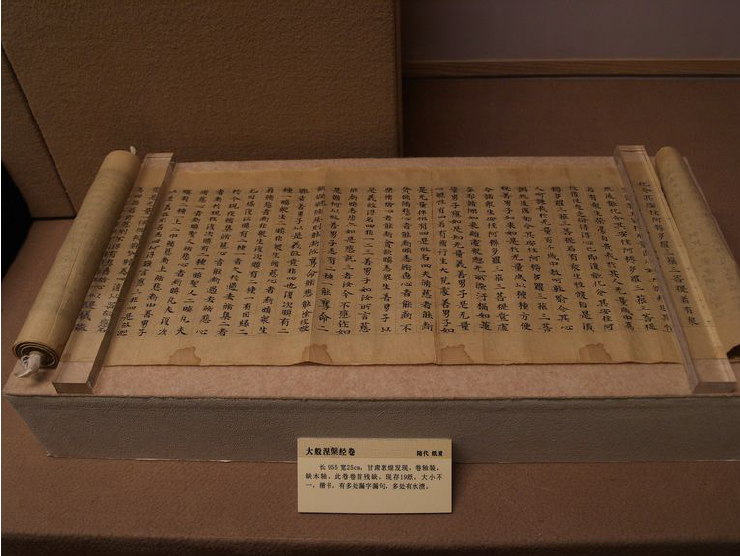
Buddhahood is the final goal of Buddhism, the perfection of compassion and wisdom, and Mahayana Buddhism is reflective of the steps that need to be taken in order to achieve this final goal. A main feature of Mahayana is the praise of Mahayana sutras. The sutras are texts believed to be the word of Buddha, and the place in which Theravada Buddhists differ from Mahayana is that these sutras are not accepted as the word of Buddha. Nonetheless, one of the main showcases of Mahayana is the praise of the sutras and the act of showering them with flowers, incense, and embalming the texts. Benevolence for all sentient beings (matter, sensation, perception, mental formations, and consciousness) is also a strong feature as it is ranked most superior comparative to the notion of nirvana, exempting oneself from suffering and rebirth. In Mahayana, Nirvana is second-rate to the concept of Buddhahood due to the perspective that Buddhahood has higher aspirations that are aimed towards infinite compassion. This higher aspiration can be defined as bodhisattva, the vow to complete perfect Buddhahood.
Obtaining bodhisattva through Mahayana is a lengthy action which brought forth the development of philosophical schools, all commonly teaching the ideology that the way we see and think stuff can be contrasted with what they truly are. The action commonly shown across these schools begins with bodhicitta (altruism). Next, they move onto Avalokitesvara (compassion) or Manjusri (wisdom). Females in this line of work are labeled Tara. In concept, all forms can reach full enlightenment. The adversity in teachings come from the adjustment the buddhists make to how advanced their audience is. Therefore, some classes are more advanced and some a little less, but in the end they all fall under the umbrella of how to achieve bodhisattva. Consequently, it is possible that the spread of Buddhism around East Asia, and Japan specifically, was prominent due to the increased flexibility of the teachings.
Japan received much of its Buddhist influence from Korea and China and began their development in Japan within the Heian period. There are numerous different types of schools present in Japan like the Tendai and Shingon, Buddha Amida, and Zen. Once again, the high variety of Buddhist schools centered in Japan can be attributed to the flexibility of the teachings between them. Most important to the topic, however, is the Nichiren; the school that teaches Mahayana way of life. The Nichiren schools in Japan put the Lotus Sutra, mentioned in paragraph one, at the center of the practice. By differing the focus, similar to the ways of Mahayana, the spotlight went from ensuring rebirth in other forms of Buddhism to faith and devotion in Mahayana and experiencing the final goal of Buddhism. This was Mahayana Japan.
Keown, Damien. Buddhism : A Very Short Introduction. Oxford University Press, 2000. Accessed 07 Feb. 2019.
Williams, Paul. “Mahāyāna Buddhism.” Encyclopedia of New Religious Movements, edited by Peter B. Clarke, Routledge, 1st edition, 2006. Credo Reference, https://muhlenberg.idm.oclc.org/login?url=https://search.credoreference.com/content/entry/routnrm/mah%C4%81y%C4%81na_buddhism/0?institutionId=4200. Accessed 07 Feb. 2019.
