Elizabeth Burch
4/11/19
Encyclopedia Entry: Kabuki Theater


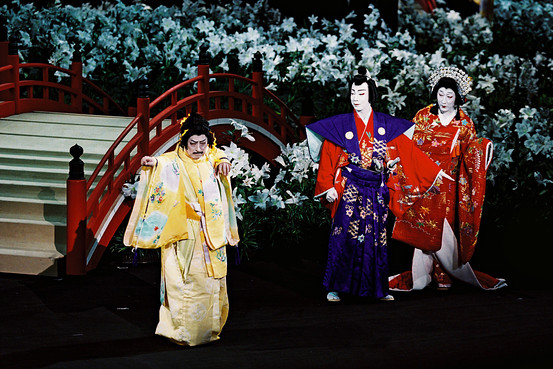
Kabuki remains a popular form of Japanese theater to this day. It features highly stylized singing, dancing, movement, and costumes.
It dates from the early 17th century, when a female dancer named Okuni performed in the Imperial Palace in Kyoto in 1603 for the emperor. (The New Face of Kabuki 1982). In the late 1500s, Okuni and her female dance group performed dances outdoors in a dry river bed. Over time, she added music and stories, turning it into a form of sensual, even erotic theater, much beloved by the commoners.
In contrast, Noh, a slightly older form of theater, was refined, simple, highly moral, and performed mostly for the aristocracy (The New Face of Kabuki 1982).
Most of Okuni’s women were also prostitutes, which led to fights among theater goers seeking favors from the actors/prostitutes (Watson and McKernie 1993). This type of performance was called “Pleasure Woman Kabuki.” The prostitution led to women being banned from the Kabuki stage in 1629 (The New Face of Kabuki 1982).
It was briefly replaced by “Young Man’s Kabuki,” which was not much better because it promoted homosexuality and was consequently abolished in 1652 (The New Face of Kabuki 1982). This was replaced by “Men’s Kabuki,” which banned sexuality and eventually became modern-day Kabuki. Kabuki means avant-guarde, signifying the break from the forms of theater in the 1600’s (Watson and McKernie 1993).
Kabuki satisfied the commoners’ desire for luxury, by using extremely lavish, brightly colored costumes (The New Face of Kabuki 1982). The exaggerated makeup, elaborate wigs, and the costumes help actors to portray various characters. There are hundreds of traditional kimonos and dozens of wig types that the audience automatically understands (Brandon, Malm and Shively 1978). Dance is critical to Kabuki and is used frequently throughout the plays (Kabuki 2017). The movements range from soft, flowing feminine to exaggerated, menacing, masculine movements. Music serves many purposes in Kabuki, such as setting a scene, indicating weather, emphasizing action, especially fights, or helping to define a character (Watson and McKernie 1993). The musical instrument most used is the samisen, a stringed instrument, accompanied by wind and percussion instruments.
Kabuki plays are centered around the actors more than the plot (Kabuki 2017). Kabuki actors are like rock stars and some become living treasures of Japan (Watson and McKernie 1993). They are trained from an early age, carry old Kabuki actor names, and are descendants of Kabuki actors.
Three types of Kabuki roles:
-aragato- rough and masculine
-wagato- soft, delicate, and feminine
-orinagato- exaggerated, idealized woman
The acting is stylized and the same movements are used in every production of a play (or Kata).
Other characteristics of Kabuki:
-high audience participation
-stage extends into audience
-includes important theatrical tricks, such as flying actors and rotating stages, not seen in previous theatrical types

Works Cited
Brandon, James R., William P. Malm, and Donald H. Shively. 1978. Studies in Kabuki. The University Press of Hawaii.
2017. “Kabuki.” Encyclopedia Britannica. April 25. Accessed April 11, 2019. https://111.britannica.com/art/Kabuki.
1982. “The New Face of Kabuki.” The New York Times Magazine. May 30. Accessed April 11, 2019. https://www.nytimes.com/1982/05/30/magazine/the-new-face-of-kabuki.html.
Watson, Jack, and Grant McKernie. 1993. A Cultural History of Theatre. New York City: Longman Publishing Group.
