Willem Birgel
31 March 2019
Encyclopedia Entry: Marco Polo and Il Milione
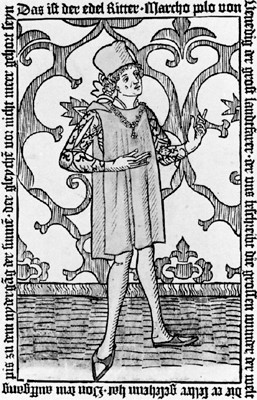
Il Milione is the name of a book by Marco Polo based on his travels (2). This book was discussed in class as an important gateway for European though as a focus on the East. Most Europeans, as far as we know, would not have given Asia a second look without knowledge of Polo’s travels.
The aforementioned travels took place in the 13th century A.D. (3). It started because Polo’s father Niccolò and Uncle Maffeo went on a trip to Asia; which eventually resulted in the group going to Peking China and visiting the court of Kublai Khan (3). After the original trip they applied for permission to go back in 1269, bringing Marco with them on an approximately four year long trip (3). Polo stayed approximately 17 years, returning to his home of Venice in 1295 (1).
At some point after this he published his book, but readers believed it to be a book of tall tales (4), or a romance in the medieval sense of the term (1) as opposed to a true story. However there is some question as to when Polo wrote the book (3). The main theory saying he was captured by the Genovese on his return to Venice and met a writer who helped to write it (1). The book may have originally been called The Description of the World and the name may have either come from Polo’s personal wealth or the French word “Emilio” (3). It may have originated from the fact that it had “millions” of tall tales about the Asian countries contained within (4). There is also no existing manuscript of the original, and the translations and manuscripts are too far removed to be useful (2).
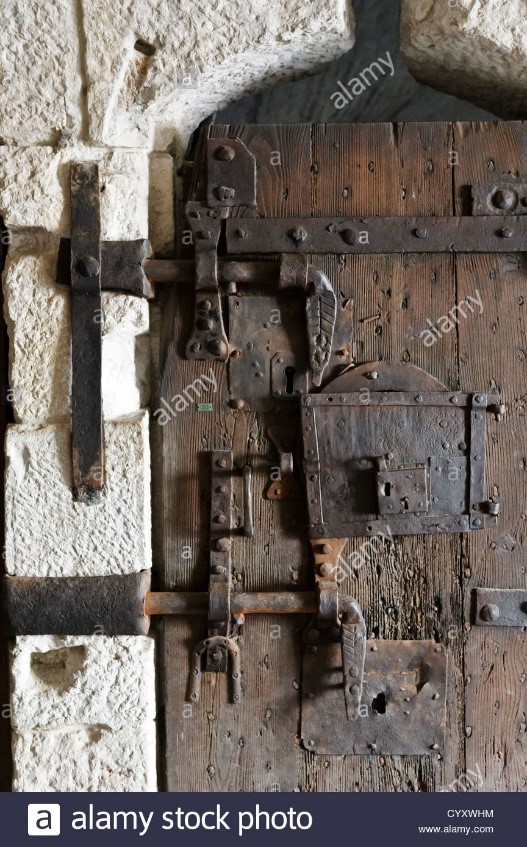
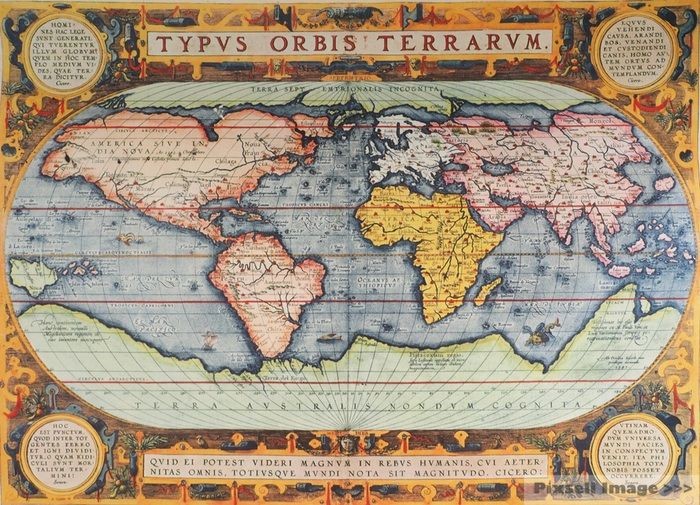
Despite the uncertainty of most things about the book, as mentioned above, it did have a large influence on how people thought about the world. The book was circulated in French, Latin, and other languages (4) and as such was very successful. With other factors including a rise in the importance of cartography and travel to the East (3.) The book’s information on geography became useful during the 15th and 16th century (2). For example, the book’s description of Japan as a land of gold inspired Columbus’ voyage towards the west (4). Columbus allegedly even brought a copy of the book with him on his journey that he wrote notes in (3).
(1) The Travels of Marco Polo. 1477. Image from Columbia University Library, New York.
Quoted in “Polo, Marco”, In Britannica Concise Encyclopedia, by Encyclopaedia
Britannica Digital Learning, 2017. https://muhlenberg.idm.oclc.org/login?url=https://search.credoreference.com/content/entry/ebconcise/polo_marco/0?institutionId=4200.
(2) “Polo, Marco The Travels of Marco Polo.” In The Hutchinson Unabridged Encyclopedia with
Atlas and Weather Guide, edited by Helicon. Helicon, 2018. https://muhlenberg.idm.oclc.org/login?url=https://search.credoreference.com/content/entry/heliconhe/polo_marco_the_travels_of_marco_polo/0?institutionId=4200.
(3) “Polo, Marco (1254 1324).” In Dictionary of Italian Literature, edited by Peter E.
Bondanella, Julia Conaway Bondanella, and Jody Robin Shiffman. 2nd ed. Greenwood, 1996. https://muhlenberg.idm.oclc.org/login?url=https://search.credoreference.com/content/entry/gwitalian/polo_marco_1254_1324/0?institutionId=4200.
(4) “Marco Polo (1254 – 1324).” In Thames & Hudson Dictionary of the Italian Renaissance,
The, edited by J. R. Hale. Thames & Hudson, 2006. https://muhlenberg.idm.oclc.org/login?url=https://search.credoreference.com/content/entry/thir/marco_polo_1254_1324/0?institutionId=4200.
(5) Alamy. “Prison Door, Doge’s Palace, Italy.” Alamy Stock Photo. No last modified date.
Photo taken 2012. https://www.alamy.com/stock-photo-prison-door-doges-palace-venice-italy-51607296.html.
(6) Pinterest. “Antique World Map.” Pinterest. No dates given.
https://www.pinterest.co.uk/pin/173247916891889108/ (Note: If you follow this link you
will need a google account to sign in. Google and Wikipedia say it’s free but I’m not
sure.)
