The shugo were an important group in Japanese history that rose to power throughout the Kamakura and Muromachi shogunates. The position of shugo was created during the Kamakura shogunate (1178-1333), though there are some references to a position during the Heian period with the same name. During the Kamakura shogunate, the position of shugo was one that was expected to raise warriors to fight for the shogun, suppress major crimes like pirating, and to punish those who committed treason.[1] The Kamakura shugo did not have much power outside of these roles as there was an organized administrative branch in use, so the shugo and their men were more of an enforcement branch for the laws of the shogunate.
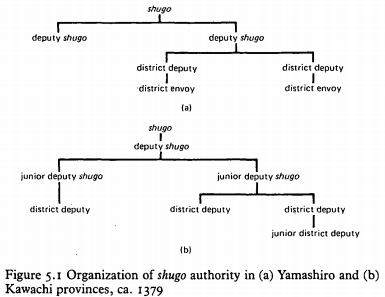
This changed with the fall of the Kamakura shogunate and the rise of the Muromachi shogunate (1336-1573). The Muromachi shogunate was not as stable as the Kamakura shogunate and due to this instability, the Muromachi had to impose wartime taxes and suppress revolts, requiring administrative powers that the shugo took on. This was an increase in power from the Kamakura shugo since they were still enforcers, but they had more power like the ability to directly levy taxes. This resulted in shugo instituting personal taxes on the peasants (hanzei) to make some extra money, which was perhaps a way to seize some power from the weak shogunate.[2] The second action the Muromachi shoguns took which led to the rise of the shugo was that shoguns, being aware of the power of the shugo, would give their vassals this position instead of land. This then led to a very interesting hierarchy in rural regions because the shugo were nobles who resided in the capital and had no real reason to go to their rural holdings, leading to a further division of the task of shugo to more and more people who were really only loyal to the person immediately above them in the hierarchy, separating the shugo from those who really had the power. As time went on and as the shogun began to fight battles in regions further away from the capital, the position of shugo would also go to families that pledged allegiance to the shogun, even if it was only done in order to keep their lands and they weren’t actually loyal to the shogun, allowing the shugo to act more independently.[3]
At the end of the Muromachi shogunate, the shugo began to return to their holdings to contact local families and began collecting private vassals of their own, creating their own private military force loyal to them and not the shogun.[4] Though some of these bakufu shugo evolved into daimyo, it was much more common for their underlings left in the provinces to gain power and eventually overthrow the shugo to become sengoku daimyo. Having seized power, these daimyo needed to legitimize their power, and one way to do so was to declare themselves the successor to a shugoposition and therefore their power came to them through the position of shugo.[5] These actions only further emphasized the fact that the position of shugowas a respected one that also held power and control over Japan and cemented its place as an important position in Japanese society during a time of great turmoil.
[1]Kozo Yamamura et al., The Cambridge History of Japan, 3. Medieval Japan:197–98.
[2]Kozo Yamamura et al., 3. Medieval Japan:198.
[3]Kozo Yamamura et al., 3. Medieval Japan:193–94.
[4]John Whitney Hall and Toyoda Takeshi, Japan in the Muromachi Age, 74.
[5]Kozo Yamamura et al., 3. Medieval Japan:226.
[6]Kozo Yamamura et al., The Cambridge History of Japan, 3. Medieval Japan:249.
