by Zeke Timen
Asking “Who is Japanese?” is not as simple as asking who was born there or grew up there. Japanese identity, especially during the Kamakura period, was determined by a combination of factors including political allegiance, geography, and adoption of court cultures and norms. Tsuchigumo sōshi (“The Tale of the Dirt Spider”) can help 21st century readers infer how the Emishi — independent peoples living on the edges of the Japanese empire — were viewed by the literate and ruling classes of the Kamakura period.
Bruce Batten highlights that in pre-modern Japan, there were not distinct categories of political, racial, cultural, and ethnic identities;{1} people were either Japanese or Not Japanese. The Emishi, despite being part of the geographic Japan, did not partake in its culture or government, and as such were seen as an ever-present threat. They were always so close to the empire, but always so far from it at the same time. This attitude manifests in Tsuchigumo sōshi through the depiction of the titular character, a “Dirt Spider.” She meets the two heroes of the story, the brave warriors Tsuna and Raikō, in a run-down house while taking the form of a gorgeous woman. She attempts to distract them for whatever purpose, but fails to catch them off-guard and is forced to retreat to her home in the mountains. The warriors find her there as a demonic spider-creature and kill her.{2}
The contrast of beauty and womanhood against being a literal giant spider is striking, and places into focus the internal conflict people went through: to acknowledge the Emishi for the innocence and humanity that they have because of their independence, or to feel hatred and fear them because they are different? Ultimately, the story points to the latter, as the spider is decapitated and her lair in the mountains (a recurring motif in describing the periphery of the empire{3}) is burnt to the ground by the brave men serving their empire. Equating a person to a spider due to cultural differences is a violent act of literature, and sums up clearly that Kamakura writers not only did not see the Emishi as Japanese, they hardly saw them as human.
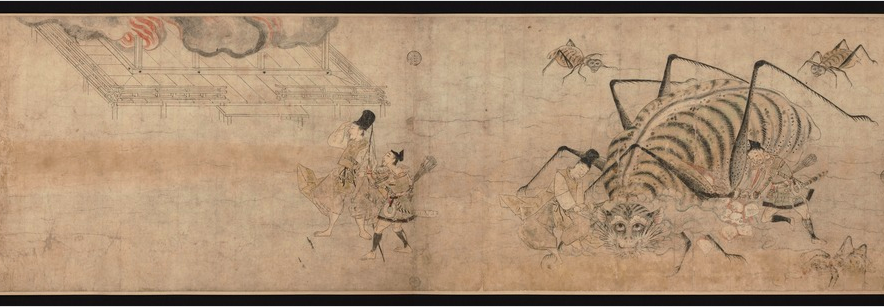
[Details from original emaki: Right – the dirt spider herself, mid-decapitation. Left – Tsuna and Raikō burning down her home]{4}
FOOTNOTES:
{1} Batten, 103.
{2} Kimbrough and Shirane, 27.
{3} Batten, 92.
{4} http://www.emuseum.jp/detail/100257/001/000?x=587&y=-47&s=1
SOURCES:
Batten, Bruce L.. To the Ends of Japan: Premodern Frontiers, Boundaries, and Interactions. Honolulu: University of Hawai’i Press, 2003.
Monsters, Animals, and Other Worlds: A Collection of Short Medieval Japanese Tales, edited by Keller Kimbrough and Haruo Shirane, 23-30. Translations from the Asian Classics. New York: Columbia Univ. Press 2018.
Important Cultural Property — 1 scroll — Color on paper — 29.2 x 975.7 — Kamakura period/13th century — Tokyo National Museum — A-18 (http://www.emuseum.jp/detail/100257/000/000?mode=detail&d_lang=en&s_lang=en&class=&title=&c_e=®ion=&era=¢ury=&cptype=2&owner=1&pos=1&num=7)
